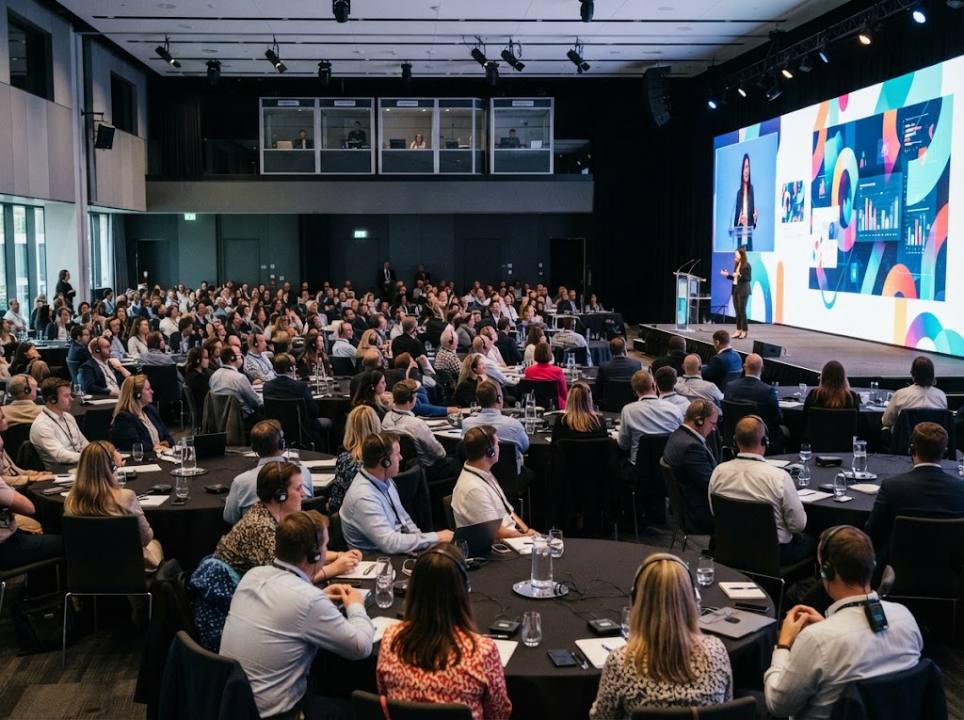
A company's annual kick-off brings together 400 employees from twelve countries. The CEO's keynote sets the strategy for the year, product teams present new launches, and regional managers run breakout sessions. If half the audience struggles to follow the main messages, the event loses much of its value, however good the content and catering.
Interpreting makes multilingual company events work. This guide covers how to plan it properly.
Start With the Audience
List the languages your attendees speak and how comfortable they are with the event's main language. Many employees understand business English but follow complex strategy or technical content more easily in their own language. Survey attendees during registration about their preferred language for sessions.
The goal is not just to translate words. It is to make sure every employee leaves with the same understanding of the company's direction.
Choose the Right Interpreting Mode
- Simultaneous interpreting: interpreters work in booths and attendees listen through headsets. Best for keynotes, panels and large sessions.
- Consecutive interpreting: the speaker pauses for the interpreter. Suits small meetings, Q&A sessions and site visits.
- Whispered interpreting: an interpreter sits next to one or two people and interprets quietly. Useful for VIP guests.
- Remote simultaneous interpreting: interpreters work from a hub, and attendees listen via an app. Practical for hybrid events.
Professional interpreting services can recommend the right mix based on the agenda, venue and budget.
Book Early and Build Teams
Experienced conference interpreters are booked months in advance, especially during busy event seasons. Simultaneous interpreters usually work in pairs per language direction and alternate every 20 to 30 minutes to maintain accuracy. Associations such as AIIC describe these working standards in detail.
Brief Your Interpreters
Interpreters perform best when they know what is coming. Provide:
- the final agenda and speaker list,
- presentations and speeches, even as drafts,
- company-specific terms, product names and acronyms,
- videos that will be played, with transcripts if available,
- key messages leadership wants to land.
Arrange a short briefing call with the speakers for the most important sessions. Five minutes of context can make a keynote far clearer in every language.
Plan the Technology
Simultaneous interpreting needs booths, consoles, a reliable sound system and receivers for attendees. Remote options need stable internet and a tested platform. Assign a technician to interpreting equipment specifically, and run a rehearsal the day before with interpreters present.
Translate What People Read
Interpreting covers the spoken word. Attendees also read slides, handouts, signage, apps and follow-up emails. Using business translation services for key materials makes sure the written message matches what interpreters say, with the same terminology for products, values and targets.
Working With a Local Partner
For events held in Britain, a translation company uk event planners can meet in person simplifies logistics: site visits, equipment, interpreter travel and on-the-day support. A single partner for interpreting and translation also keeps terminology consistent across spoken and written content.
Tips for Speakers
- Speak at a natural pace and pause between key points.
- Avoid reading slides at high speed.
- Explain acronyms and internal jargon.
- Be careful with jokes that rely on wordplay.
- Share any last-minute changes with interpreters immediately.
Hybrid and Recorded Sessions
Many company events now stream sessions to remote employees and record them for later viewing. Interpreted audio channels can be streamed alongside the main feed, and recordings can be subtitled afterwards. Plan this from the start so the technical setup captures each language channel cleanly.
Budgeting
Interpreting is usually priced per interpreter per day, plus equipment, preparation and travel. Remote interpreting can reduce travel costs, but still requires professional teams and technical support. Build the budget early and avoid last-minute bookings, which limit availability and increase costs.
Measure the Impact
After the event, ask attendees how well they understood the sessions in their language. Feedback by language reveals where interpreting, materials or speaker habits need improvement next time.
Breakout Sessions and Workshops
Large plenary sessions get most of the attention, but much of the real work at company events happens in smaller breakout rooms. These sessions are harder to cover, because they run in parallel and change at short notice. Decide in advance which breakouts need interpreting, group attendees by language where possible and consider portable tour-guide systems, which allow an interpreter to work in any room without fixed booths.
Workshops with group exercises benefit from bilingual facilitators or interpreters who can move between tables. Prepare exercise sheets in the main languages, so participants can work in the language they think in, and share results in the common language at the end.
Q&A and Audience Participation
Questions from the floor are often the most valuable part of a session and the most difficult to interpret. Make sure roaming microphones are always used, ask moderators to repeat or summarise questions, and allow attendees to submit questions in their own language through an app, with interpreters or translators preparing them for the speaker.
Final Thoughts
A multilingual company event succeeds when every employee hears the same message clearly. With the right interpreting mode, early booking, thorough briefings, reliable technology and translated materials, organisers can turn language diversity into a strength of the event.